Morphogenesis ← Liquid Fragmentation → Architecture of the Scar
LIQUID FRAGMENTATION
ARTISTIC INQUIRY
How does form fragment and reorganise?
2014–2019 · NORWAY
Retrospective framework articulated in 2026
The landscape was still outside.
The form had already begun to turn inward.
Following MORPHOGENESIS, the question shifted from how form begins to what happens when form fragments, repeats and reorganises.
Developed in Norway through sustained observation of water, weather and changing states of matter, LIQUIDFRAGMENTATION moved from landscape and colour toward fragments, repetition and modular composition.As the work changed, attention gradually shifted from what was being observed to the relations forming within the work itself.

I. WATER, FREEDOM AND COLOUR
Moving from Mexico City to Trondheim changed the conditions surrounding the work. Seasonal darkness, cold,wind and the changing states of water became a sustained field of observation.
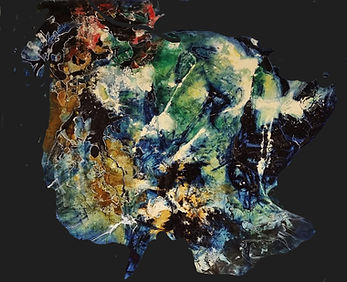
Water became associated with freedom through its capacity to transform: to flow, freeze, dissolve and assume new configurations. Temperature, pressure, humidity and time gradually entered the paintings through changes in gesture, surface and density.
Blue opened the pictorial field through movement and depth. Red compressed it, introducing greater frictionand intensity. As the palette darkened, the surfaces began to retain what had previously moved across them.

Microscopic Water Creatures
2014
Plaster relief, oil, acrylic and engraving ink on canvas
100 x 100 cm
Trondheim-Norway

Inner Nature
2017
Plaster relief, oil, acrylic and engraving ink on canvas
134 × 185 cm
Trondheim, Norway

Top-down View of Water Landscape
2015
Plaster relief, oil, acrylic and engraving ink on canvas
134 × 185 cm
Trondheim, Norway

Fragments of the Earth, Space View
2014
Plaster relief, oil, acrylic and engraving ink on wood
60 × 120 cm
Trondheim, Norway
Digital Visualization
Digital Visualization
Digital Visualization
Digital Visualization
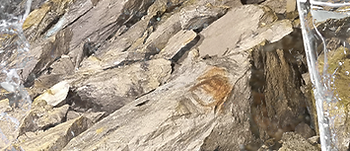
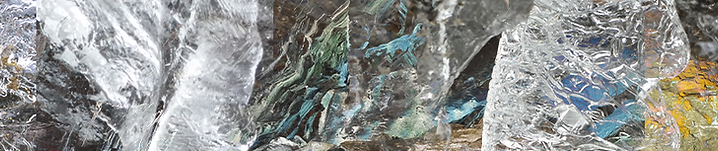
II. FIELDOBSERVATION Røros, Norway.
Water, ice, and mineral structures in transformation.
Surface, depth, and time.
III. THE ELEMENTS OF THE LAST MINUTE
HISTORICAL DEVELOPMENT · 2015–2016
The Elements of the Last Minute brought together ninety-four individually produced ceramic elements within a structure derived from the periodic table. Each piece was made separately and then placed in relation to the others, allowing differences in colour, density, gesture and surface to accumulate across the mural.
The periodic table provided the organising structure for the mural. Individual elements remained distinct within a larger field. Repetition, interval and proximity changed how each fragment was perceived in relation to the whole.
The title refers to the compressed interval occupied by human history within the cosmic calendar. The individual elements hold separate moments, while the mural brings them together within a shared material field.
RETROSPECTIVE READING · 2026
Looking back at the work in 2026, a recurring sequence becomes visible: making, observing, recognising relations and reorganising what has appeared. The composition developed through successive arrangements; each altered the conditions for the next decision.
Seen retrospectively, the fragments begin to operate like a vocabulary. Their repetitions, differences and intervals create a provisional grammar that changes as the elements are rearranged. What began as modular composition can now be recognised as an early form of the recursive process that would later become explicit within Percepción Encarnada.


The Elements of the Last Minute
2015–2016
Oil, acrylic and engraving ink on 94 ceramic tiles
630× 290 cm
Trondheim, Norway
Digital Visualization
Making
Observing
Recognizing relations
Reorganizing
New perception
Retrospective process diagram, 2026

The Elements of the Last Minute
2015–2016
Oil, acrylic and engraving ink on 94 ceramic tiles
630× 290 cm
Trondheim, Norway

The Elements of the Last Minute
2015–2016
Oil, acrylic and engraving ink on 94 ceramic tiles
630× 290 cm
Trondheim, Norway

The Elements of the Last Minute
2015–2016
Oil, acrylic and engraving ink on 94 ceramic tiles
630× 290 cm
Trondheim, Norway
PROCESS DOCUMENTATION
The Elements of the Last Minute, 2015–2016
The works produced the conditions through which the method could later be recognised.
Retrospective reflection, 2026
IV. EXHIBITION MEMORY
Marienborg Gallery, Trondheim, Norway
This exhibition predates the retrospective articulation of LIQUID FRAGMENTATION and is included here as part of its archive. At Marienborg Gallery, paintings, modular elements, sculpture and projection occupied the exhibition space together. Small fragments, larger pictorial fields and three-dimensional works appeared in direct proximity,making changes of scale and material physically visible within the installation.
Exhibition concept and curatorial framework by Daniel Romero Nieto
The Elements of the Last Minute
EXHIBITION DOCUMENTATION
Chronicle of art@science
Marienborg Gallery · Trondheim, Norway
V. EMBODIED FORMS
CURATORIAL CHAPTER · WORKS 2015
The sculptures presented here were produced in 2015 within the Anthropomorphic Elements series and are brought together retrospectively as Embodied Forms.
After working through fragments and modular composition, the process moved into three dimensions. Clay introduced weight, cavity, balance, resistance and gravity. Forms developed through handling, joining, pressing and responding to the material as it changed.
Seen from 2026, these works mark a shift from surface and fragment toward bodily and spatial presence. Relations expanded into mass, void, scale and the position of the viewer.
.png)
Liberation from Suffering
Anthropomorphic Elements
2015
Glazed fired clay
20 cm high
Trondheim, Norway
Digital Visualization
.png)
Penitence
Anthropomorphic Elements
2015
Glazed fired clay
26 cm high
Trondheim, Norway
Digital Visualization
.png)
Distress
Anthropomorphic Elements
2015
Glazed fired clay
10 cm high
Trondheim, Norway
Digital Visualization
.png)
Anthropomorphic Couple
Anthropomorphic Elements
2015
Glazed fired clay
15 cm high
Trondheim, Norway
Digital Visualization
.png)
Resignation
Anthropomorphic Elements
2015
Glazed fired clay
11 cm high
Trondheim, Norway
Digital Visualization
.png)
The Forgiveness
Anthropomorphic Elements
2015
Glazed fired clay
18 cm high
Trondheim, Norway
Digital Visualization
VI. BODY, MEASUREMENT & MACHINE
Within the Anthropomorphic works, the body began to appear alongside questions of measurement, construction and artificial form. Anthropoid—Human Without Nature marks this brief threshold between bodily presence and constructed order.
TRANSITIONAL CHAPTER · 2015

Anthropoid—Human Without Nature
2015
Glazed fired clay
10 cm high
Trondheim, Norway
VII: TOWARD THE SCAR
CONTAINMENT, TRACE AND DURATION
As the palette became darker and more contained, movement began to remain within the surface as density, fissure and accumulated trace. What had previously circulated across the paintings started to register aspressure, duration and material retention. Seen retrospectively, these works mark the point at which the surface begins to carry conditions that would later become central to Architecture of the Scar.