Morphogenesis ← Liquid Fragmentation → Architecture of the Scar
ARCHITECTURE OF THE SCAR
ARTISTIC INQUIRY
When does a scar become structure?
2020–PRESENT · DRAWING · PRINTMAKING · RELIEF
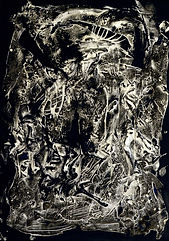
ARCHITECTURE OF THE SCAR emerged from a hybrid process combining intaglio and collagraphy. Wooden matrices were first carved, incised and excavated through intaglio-based operations, then built up and modelled with gypsum plaster through collagraphic procedures. Initially, the matrices were inked and printed on cotton paper. Gradually, the matrices themselves became the work.

I. CONCEPT & CURATORIAL POSITION
CONCEPT
ARCHITECTURE OF THE SCAR begins from a biographical relation to the scar. The experience is translated into material operations: cutting, excavating, adding, covering and returning to the surface. Pressure and change remain visible through depth, accumulation, interruption and removal.
A trace does more than record what happened. It begins to reorganise what comes after.
CURATORIAL POSITION
Drawing, printmaking and relief operate as connected material states. Lines become incisions; incisions become cavities; surfaces are excavated and built up. Density, void, edge and depth gradually move the work from the page and printed trace toward physical and spatial presence.

Digital Visualization
II. FROM TRACE TO STRUCTURE
The use of plaster and relief continues material experiments already present in LIQUID FRAGMENTATION. Printmaking introduced another set of operations: the matrix, pressure, incision and the transfer of a worked surface onto paper.
In ARCHITECTURE OF THE SCAR, these two lines of work began to overlap. Birch plywood matrices were first carved, incised and excavated through intaglio-based operations. Gypsum plaster was then added and modelled through collagraphic procedures, building relief back onto the surface. The matrices were initially inked and printed on cotton paper; their accumulated surfaces gradually became more important than the impressions they produced.
The matrix then shifted from tool to artwork. Relief, cavity and edge were developed directly on the wooden support. Intaglio ink was rolled across the worked surface, followed by ultra-matte acrylic paint in recessed areas. Ink and matte paint respond differently to light, intensifying depth through reflection and absorption.
The sequence gives the scar a material logic of subtraction, accumulation and return.
DRAWING
Line establishes direction, interruption and repetition.

DRAWING 01

DRAWING 02
INTAGLIO
Incision converts line into pressure and depth.

INTAGLIO 01

INTAGLIO 02
MATERIAL WORK
The matrix becomes a surface that can be excavated, built up and retained as the work itself.


MATERIAL WORK 01
MATERIAL WORK 02
MATERIAL WORK 03
III. PROCESS
The surface is worked repeatedly: cut and excavated, built up with gypsum plaster, allowed to dry, then carved, ground and incised again. Each return changes the topography of the birch plywood support, opening cavities, edges and differences of depth.
The worked surface is then inked with intaglio ink and finished with ultra-matte acrylic paint. Ink catches and reflects light differently from the recessed matte areas, which absorb it. The final image develops through pigment, relief, surface and light.
Each intervention remains partially visible. Subtraction creates conditions for addition; the added relief creates new surfaces that can be removed again. Repeated returns to the same surface drive the work.
IV. SELECTED CORPUS

SCAR 01
2018
Wood, ink, relief, excavation
120 x 80cm
Trondheim, Norway

SCAR 02
2018
Wood, ink, relief, excavation
120 x 80cm
Trondheim, Norway
PROCESS DOCUMENTATION


SCAR 03
2018
Wood, ink, relief, excavation
60 x 40cm
Trondheim, Norway
SCAR 04
2018
Wood, ink, relief, excavation
60 x 40cm
Trondheim, Norway
SCAR 05
2018
Wood, ink, relief, excavation
60 x 40cm
Trondheim, Norway
SCAR 06
2018
Wood, ink, relief, excavation
60 x 40cm
Trondheim, Norway
V. THE WORK IN SPACE
DOCUMENTED
Trondheim Open 2024
Presented in space, the reliefs change with distance, viewpoint and light. Their excavated surfaces become more legible obliquely than frontally, while shadows and reflections shift as the viewer moves around them.

Digital Visualization
PROPOSED
Kullbingen · Nyhavna
SITE-SPECIFIC PROPOSAL · UNREALISED
For Kullbingen at Nyhavna, ARCHITECTURE OF THE SCAR was developed beyond the individual relief into aspatial configuration of fifteen suspended works. The proposal tested a suspended spatial configuration within the industrial architecture.
Suspension allows the works to be approached from different sidesand introduces the surrounding space,structure and movement of the viewer into the installation. The proposal remains unrealised and is presentedhere as a site-specific study.

SITE-SPECIFIC PROPOSAL VISUALIZATION · APPROXIMATE SCALE
Kullbingen · Nyhavna, Trondheim
Digital Visualization
VI. A CONTINUOUS INQUIRY
VII. TOWARD PERCEPCIÓN ENCARNADA
Across the three projects, the questions change as materials, scales and working conditions change. Each project emerged from the material problems of its own period while leaving questions that continued into the next.
MORPHOGENESIS
EMERGENCE
Where does form begin?
LIQUID FRAGMENTATION
REORGANIZATION
How does form fragment and reorganise?
ARCHITECTURE OF THE SCAR
INSCRIPTION
When does a scar become structure?
In ARCHITECTURE OF THE SCAR, the body becomes more visible through the way surfaces are worked, resisted and revisited. Pressure, depth, repetition and material response begin to raise questions about how perception is shaped through action and contact.
These questions continue in PERCEPCIÓN ENCARNADA, where the body is approached more directly as a site of observation, attention and artistic inquiry.