Morphogenesis ← Liquid Fragmentation → Architecture of the Scar
Architecture of the Scar
Embodied Memory as a Material Structure
When does a scar become structure?
DANIEL ROMERO NIETO / DARONI
Supported by the research and development platform
PERCEPCIÓN ENCARNADA

I. CONCEPT & CURATORIAL POSITION
CONCEPT
Architecture of the Scar begins with the scar as a structure formed through transformation. Across drawing, printmaking and material works, pressure, interruption, sedimentation and residual change organize the surface.
Architecture of the Scar shifts the scar from image to operation: pressure, interruption, sedimentation and residual change organize surface and space, carrying embodied experience into material structure.
Across the project, a trace does more than record what happened. It begins to reorganize what comes after.
CURATORIAL POSITION
Across the works, cuts, depressions, accumulated matter, density and void form a shared material syntax. Each surface retains different traces of pressure and alteration, allowing the project to move between drawing, printmaking, relief and spatial relation, and increasingly across different scales.
WHY IT MATTERS NOW
In a time when bodies are increasingly measured, imaged and categorized, Architecture of the Scar returns attention to material experience. Memory appears through pressure, repetition, resistance and change, remaining present as surface, depth and spatial relation.

II. FROM TRACE TO STRUCTURE
Drawing and printmaking establish relations between line, pressure, interruption and repetition. As these operations move into the material works, the surface gains depth, resistance and duration.

DRAWING 01

DRAWING 02

INTAGLIO 01

INTAGLIO 02


MATERIAL WORK 01
MATERIAL WORK 02
MATERIAL WORK 03
III. PROCESS
The surface is worked repeatedly: cut, built up, removed, covered and returned to. Wood, plaster, acrylic and printing ink accumulate through successive interventions, each one changing what can be seen and what can happen next.
The process film follows one work from the preparation of the support to its final surface.
IV SELECTED CORPUS


SCAR 01
2018
Wood, ink, relief, excavation
120 x 80cm
Trondheim, Norway
SCAR 02
2018
Wood, ink, relief, excavation
120 x 80cm
Trondheim, Norway
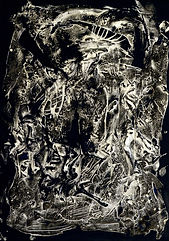


SCAR 03
2018
Wood, ink, relief, excavation
60 x 40cm
Trondheim, Norway
SCAR 04
2018
Wood, ink, relief, excavation
60 x 40cm
Trondheim, Norway
SCAR 05
2018
Wood, ink, relief, excavation
60 x 40cm
Trondheim, Norway
SCAR 06
2018
Wood, ink, relief, excavation
60 x 40cm
Trondheim, Norway
V. THE WORK IN SPACE
DOCUMENTED
Trondheim Open 2024
Nyhavna · Trondheim
During Trondheim Open 2024, the works were shown in the Nyhavna studio, where scale, distance, light and architecture entered their reading. Seen together, the surfaces began to operate beyond the limits of the individual work.

PROPOSED
Kullbingen · Nyhavna
UNREALIZED SITE-SPECIFIC PROPOSAL
For Kullbingen, the works were developed as a possible second skin for the concrete architecture of Nyhavna. Separation from the wall, suspension, shadow and circulation were tested as ways of extending the work into the volume of the space.

VI. A CONTINUOUS INQUIRY
MORPHOGENESIS
EMERGENCE
Where does form begin?
Material behaviour becomes a way of questioning how form appears.
LIQUID FRAGMENTATION
REORGANIZATION
How do fragments organize into systems?
Fragmentation shifts the work toward relation, accumulation and changing fields.
VII. A CONTINUOUS INQUIRY
ARCHITECTURE OF THE SCAR
INSCRIPTION
When does a scar become structure?
The inquiry shifts from how fragments reorganize to what remains after transformation. Pressure, duration and interruption begin to organize surface, depth and space.
Within the series, density, rupture and resistance become conditions that can be observed, compared and carried into spatial relation.
Architecture of the Scar makes the body increasingly visible as a condition of perception, material action and spatial relation. These questions continue through Percepción Encarnada, where the body becomes an explicit field of artistic research.
EMERGENCE · REORGANIZATION · INSCRIPTION
Within DARONI, Architecture of the Scar carries the inquiry from material reorganization toward inscription, spatial relation and public encounter.